
 Get a Quote

 Send Inquiry
Sulfuric Acid
Price 78 INR/ Kilograms
Sulfuric Acid Specification
- Molecular Weight
- 98.08 g/mol
- Storage
- Store in tightly closed containers, in cool, dry, well-ventilated areas, away from incompatible materials
- Taste
- Not applicable (highly corrosive and toxic)
- CAS No
- 64-19-7
- Application
- Used in fertilizers, chemical manufacturing, batteries, cleaning agents, petroleum refining
- Poisonous
- YES
- Density
- 1.84 Gram per cubic centimeter(g/cm3)
- Grade
- Industrial Grade
- Purity
- 98%
- Appearance
- Clear, colorless to slightly yellow liquid
- Refractive Rate
- nD 1.429
- Product Type
- Acid
- Molecular Formula
- H2SO4
- Shelf Life
- Stable under recommended storage conditions
- EINECS No
- 231-639-5
- Ingredients
- Sulfur trioxide dissolved in water
- HS Code
- 28070000
- Shape
- Liquid
- Ph Level
- <1 (strong acid)
- Solubility
- Miscible with water (exothermic reaction)
- Melting Point
- 10.31°C
- Usage
- Industrial and laboratory applications
- Properties
- Clear, pungent odor, corrosive
- Smell
- Pungent, suffocating odor
- Structural Formula
- O=S(=O)(O)O
- Physical Form
- Liquid
- Packaging
- Available in HDPE drums, bulk tanks
- Viscosity
- 24.5 cP (at 25C)
- Transport Information
- UN Number: 1830, Class: 8 (Corrosive Liquids)
- Handling Precautions
- Use protective equipment: gloves, goggles, face shield
- Auto-Ignition Temperature
- Not flammable
- Compatibility
- Incompatible with organic materials, strong reducing agents, metals
- Corrosive Nature
- Severe
- Boiling Point
- 337C
- Vapor Pressure
- 0.3 mm Hg (at 20C)
- Decomposition Temperature
- Decomposes above 300C
Sulfuric Acid Trade Information
- Minimum Order Quantity
- 25000 Kilograms, ,
- Supply Ability
- 500 Kilograms, , Per Month
- Delivery Time
- 7 Days
About Sulfuric Acid
Sulfuric AcidSulfuric Acid was also known as Oil of Vitriol, is used in mineral processing, fertilizer manufacturing, waste water processing, chemical synthesis and in oil refining.
Our clients can get Sulfuric acid at a very competitive price.
Usage :
Sulfuric acid also written as Sulphuric acid, widely find its usage in the manufacturing of:
- Detergents
- Synthetic resins
- Dyestuffs
- Pharmaceuticals
- Fertilizers
- Petroleum catalysts
- Insecticides
- Antifreeze Agents
Sulphuric Acid is also used in applications like:
- Oil well acidizing
- Paper signing
- Aluminium reduction
- Water treatment
It finds application in paints, lubricants, batteries, enamels, printing inks, textiles, water fabrics, paper and varied other products.
Packaging:
We offer Sulfuric Acid in bulk quality in tanker loads and in small quantity in carboys and jerry cans. These are available in various grades such as technical/commercial grade, CP grade, LR grade and AR grade. Clients can also avail from us dilute and waste sulfuric acid in quality packaging.
Features
- Accurate composition
- Optimum quality
- Highly soluble in water
- Longer shelf life
Key Properties of Sulfuric Acid
Sulfuric acid exhibits several critical features: it is a clear to slightly yellow liquid, highly corrosive, and a strong oxidizer. It possesses a pungent, suffocating odor and is miscible with water, resulting in an exothermic reaction. Its molecular formula is H2SO4, and its classified as a Class 8 corrosive liquid with UN Number 1830 for transport. Due to its severe toxicity, protective gear must always be worn during handling.
Safe Handling and Storage
Proper handling of sulfuric acid requires protective equipment such as gloves, goggles, and a face shield to prevent exposure. Store the acid in tightly closed containers made of compatible materials, such as HDPE drums, in cool, dry, and well-ventilated areas. Keep it away from organic matter, metals, and strong reducing agents. These precautions ensure user safety and maintain product integrity.
Industrial and Laboratory Uses
Widely used in the manufacture of fertilizers, chemicals, and cleaning agents, sulfuric acid is also integral to petroleum refining and batteries. Its strong acidity and oxidizing capability make it valuable in processes requiring a powerful reactant. Laboratories employ sulfuric acid for analytical purposes and as a reagent, benefiting from its high purity grade and stable shelf life.
FAQs of Sulfuric Acid:
Q: How should sulfuric acid be safely handled and stored?
A: Sulfuric acid must be handled with chemical-resistant gloves, goggles, and a face shield to prevent contact. It should be stored in tightly sealed HDPE drums or bulk tanks, kept in cool, dry, and well-ventilated areas away from incompatible materials like metals, organics, and strong reducing agents.Q: What are the primary industrial uses of sulfuric acid?
A: Industrial applications for sulfuric acid include manufacturing fertilizers, chemicals, batteries, and cleaning agents. It is also essential in petroleum refining and is commonly used for diverse laboratory processes due to its strong acidity and reactive nature.Q: When should sulfuric acid be transported, and under what conditions?
A: Sulfuric acid should be transported in compliance with regulations for Class 8 corrosive liquids, under UN Number 1830, using compatible packaging such as HDPE drums. Transport should ensure secure containment, with safety protocols to mitigate leaks and exposure.Q: Where is sulfuric acid typically distributed and supplied in India?
A: Sulfuric acid is distributed across India by industrial suppliers, distributors, and traders serving sectors like agriculture, manufacturing, laboratories, and refining industries. It can be sourced in bulk or packaged form depending on the end-use requirements.Q: What are the key benefits of using sulfuric acid in manufacturing processes?
A: Sulfuric acids benefits include its ability to catalyze reactions, act as a powerful dehydrator, and serve as a strong oxidizer, making it invaluable for chemical synthesis, fertilizer production, and refining applications. Its high purity and stable physical properties enhance process efficiency.Q: How does sulfuric acid react with water and organic materials?
A: Sulfuric acid reacts violently and exothermically with water, releasing significant heat, and can decompose or cause fires when combined with organic materials. Always add acid to water slowly to minimize risk of splashing and overheating.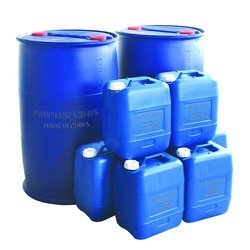

Price:
- 50
- 100
- 200
- 250
- 500
- 1000+

More Products in Inorganic Chemicals Category
Magnesium Sulphate
Price 78 INR / Kilograms
Minimum Order Quantity : 25000 Kilograms
CAS No : 64197
Purity : 99% Min
Usage : Used as a fertilizer, food additive, brewing salt, in pharmaceuticals (Epsom Salt), in bath salts and as a coagulant.
Properties : Clear, pungent odor, corrosive
Nitric Acid
Price 36.0 INR / Kilograms
Minimum Order Quantity : 1500 Kilograms
CAS No : 64197
Purity : 60%
Usage : Industrial, Laboratory, Fertilizers
Properties : Clear, pungent odor, corrosive
Sodium Methoxide
Price 78 INR / Kilograms
Minimum Order Quantity : 25000 Kilograms
CAS No : 64197
Purity : 99%
Usage : Used as a reagent in chemical processes such as esterification transesterification and condensation reactions
Properties : Clear, pungent odor, corrosive
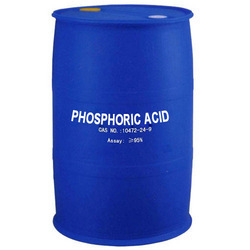
Phosphoric Acid (Orthophosphoric Acid)
Price 130.0 INR / Kilograms
Minimum Order Quantity : 2500 Kilograms, Kilograms
CAS No : 64197
Purity : 99%
Usage : Phosphoric Acid is widely used in waste water treatment chemicals, activated carbon, soaps and detergents etc.
Properties : Clear, pungent odor, corrosive


- Office No.5, 1st Floor, Shreenath Shopping Centre, D.J.Road, Vile Parle West,Mumbai - 400056, Maharashtra, India
- Phone : 08045800160
GST : 27AAAFP2040B1ZZ

- Mr Devang Dinesh Parikh (Partner)
- Mobile : 08045800160
- Send Inquiry
 Send Inquiry
 Send Inquiry
 Send SMS
 Call Me Free
Developed and Managed by Infocom Network Private Limited.
 English
 Spanish
 French
 German
 Italian
 Chinese (Simplified)
 Japanese
 Korean
 Arabic
 Portuguese